Getting Mice Out of the Walls in San Antonio
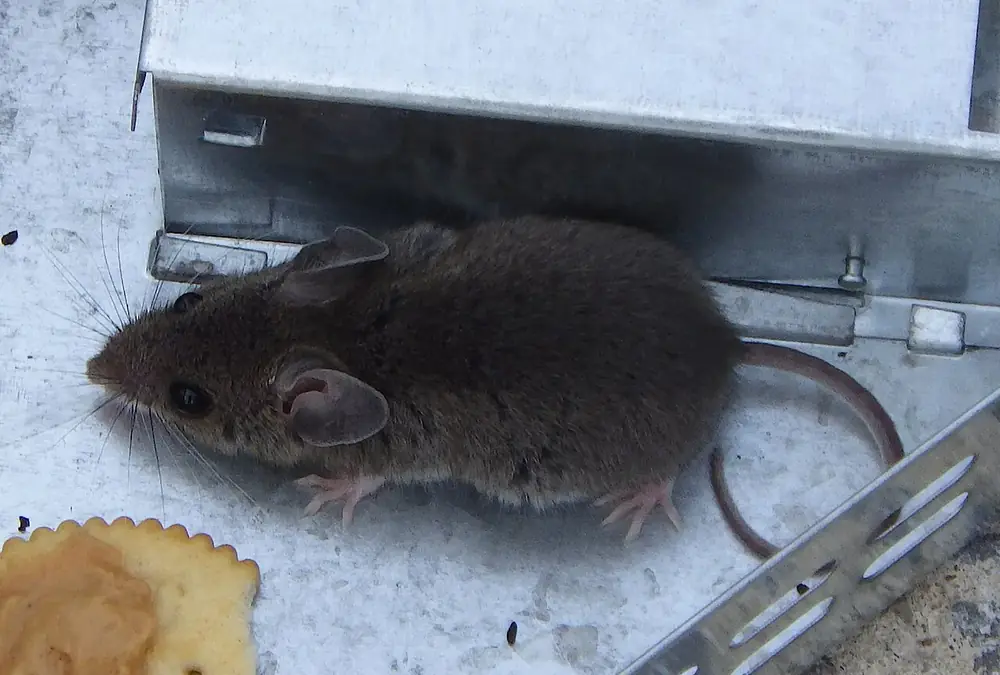
Scratching inside a wall at night makes people a little crazy. You can hear it, you can pinpoint it to a few feet, and you can't do anything about it with a flashlight. Most of the time it's house mice. They live in the wall cavity, travel along the studs and plumbing, and come out at night to feed in the kitchen or the garage.
The answer is rarely to cut the wall open. A technician works out how the mice get into the wall from outside, traps them where they come out of the wall inside, and seals the entry so new ones can't follow.
- Light scratching or scurrying in a wall, mostly at night
- Droppings under the sink, behind the stove or in a drawer near the wall
- Small holes chewed around pipes under cabinets
- A pet staring at or pawing one spot on the wall
How mice get into San Antonio walls
Brick and stone veneer is the big one. The bottom row of brick has open weep holes, and behind the brick is a gap and then the wall sheathing. A mouse goes in a weep hole, climbs the gap, and finds a way into the stud cavity where a pipe, a wire or the sill plate leaves an opening. From there it can reach the kitchen through the gap around the sink drain.
Other routes: the hole where the AC line set and condensate line pass through the wall, the dryer vent, and gaps under the garage-to-house door. On older pier-and-beam houses, mice come up from the crawl space along the plumbing.
- Open weep holes along the bottom brick course
- AC line set and condensate line holes
- Dryer vent hoods with stuck or missing flaps
- Gaps around plumbing under sinks
- Garage-to-house walls and door frames
What a thorough job includes
Mice in walls are a sealing job with trapping on the side. A good provider will:
- Find the exterior gaps leading into the wall, low on the house
- Find where the mice come out inside, often under a sink or behind an appliance
- Set snap traps at those exit points, out of reach of kids and pets
- Fit weep hole screens and pack pipe gaps with copper or stainless mesh
- Seal interior pipe penetrations under cabinets
- Come back to check traps and confirm the scratching has stopped
Noise in the attic tonight? Talk to someone who handles San Antonio rodents.
Call (210) 955-2948
Step by step
Day one is inspection and trap placement. The technician may leave the main outside gap open for a few days so mice inside the wall come out to feed and get caught, rather than dying in the cavity. Over the next week or two, traps get checked and moved. Once catches drop off, the last outside gaps are sealed. A final visit confirms the wall has gone quiet.
Why not seal everything on the first day? A mouse sealed inside a wall will chew a new way out, sometimes into a closet, or die in there and leave a smell.
What you can check yourself
Walk the outside of the house and look at the bottom row of brick. Count how many weep holes are open. Look at where the AC lines and the condensate line go into the wall, and at the dryer vent flap. Inside, open the cabinet under the kitchen sink and look at the gap around the drain and supply lines. Droppings there mean that's an exit point. A few snap traps baited with a smear of peanut butter, set flush against the wall under that sink, will tell you a lot in two or three nights.
Why it takes patience here
A typical San Antonio house has dozens of weep holes, and most were left open by the builder. Screening every one takes time, and missing a few means mice keep finding a way in. Long ranch houses from the 1960s and 1970s, common in places like Leon Valley and the Northeast Side, have a lot of wall to cover.
Our mild winters mean mice never fully leave. You might hear them less in summer and more after a cold front, but they don't disappear on their own.
Questions from callers
Can I just put poison in the wall?
That's how people end up with a dead mouse in the wall and a smell for weeks. Traps at the exit points and sealing are cleaner.
Will they leave if I bang on the wall?
They'll go quiet for a while. They won't leave.
Do I need to open the wall?
Rarely. Mice come out to eat, so trapping where they exit works without cutting drywall.
Is it mice or rats in my wall?
Light, quick scratching low in the wall is usually mice. Heavier movement up high near the ceiling is more often a roof rat. See rodent noises at night.
Can I fill the weep holes with mortar?
No. They let water drain from behind the brick. Use screens or inserts made for weep holes.
Noise in the attic tonight? Talk to someone who handles San Antonio rodents.
Call (210) 955-2948
Related reading
- How small a hole can a mouse or rat get through?
- Noises in the ceiling or walls at night: rats, mice or something else?
- Steel wool vs copper mesh for sealing out mice and rats
We take calls from Alamo Heights, Olmos Park and Terrell Hills, Stone Oak, Timberwood Park, Leon Valley, Castle Hills and Shavano Park, Medical Center, Windcrest, Live Oak and Universal City, Leon Springs and Fair Oaks Ranch, Beacon Hill and Five Points, South Side and the Missions, Monte Vista, King William and Southtown, Tobin Hill and the Pearl, Dignowity Hill and the East Side, Woodlawn Lake and Jefferson, Helotes, Alamo Ranch, Schertz and Cibolo, Boerne, New Braunfels.